Chunyang Wang王春阳

AI for PhysicsMultiphase Flow in Porous Media

Ph.D. Student, Imperial College London

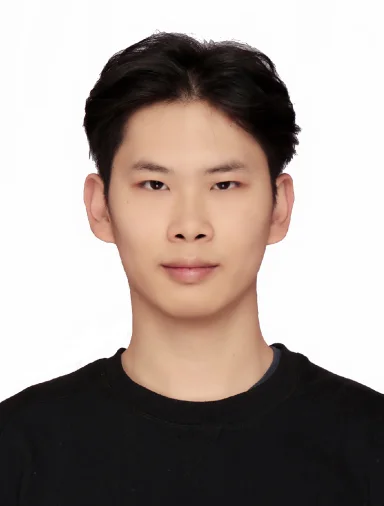
Portrait of Chunyang Wang

My research in a nutshell Runs in your browser

Multiphase flow in porous media is everywhere: carbon dioxide and hydrogen stored in rock deep underground, rain soaking into soil, water draining from a fuel cell, espresso pushed through a coffee puck.

Simulating it is slow, so neural networks can learn to predict it instead. Try it yourself: shape a network, train it on one simulated porous material, then see how well it predicts this one. Everything, training included, runs in your browser.

Simulation
Your network
grainswaterinvading fluidDrainage simulated by invasion percolation.
Pore sizeSize vs. nearbyEntry throatNext throatWet sidesWet aroundWet in 5×5Filled last stepFilled step beforeFillsnext

Weights: positive negative, thicker is stronger.

training loss validation loss, by training step

About

I am a Ph.D. candidate at Imperial College London, supervised by Dr. Gege Wen and Prof. Samuel Krevor. I am broadly interested in AI and machine learning for physics, with an emphasis on fluid dynamical systems. My Ph.D. focuses on modelling multiphase flow in porous media: how different fluids displace one another inside complex, microscale structures such as rock. This research is closely tied to energy systems and a sustainable future, from storing carbon dioxide deep underground to storing hydrogen for clean energy.1

I obtained my MSc in Applied Computational Science and Engineering from Imperial College London, under the supervision of Dr. Stephan Kramer and Prof. Matthew Piggott, and my BEng in Computer Science and Information Technology from Southwest University.

Footnotes

  1. Underground storage relies on rock whose tiny pores are filled with salty water, which the injected gas must push aside. See the British Geological Survey, Understanding carbon capture and storage. ↩

Research

  • AI/ML for physics. Neural surrogate models that learn physical systems from data, with an emphasis on fluid dynamics.
  • Computational methods. Lattice Boltzmann methods for modelling multiphase flow, finite element methods and mesh adaptation.

News

  • I was awarded a Janet Watson Ph.D. Studentship and will be starting my Ph.D. project in Sep. 2024 at Imperial College London.

  • I obtained my MSc degree from Imperial College London with Distinction.
Publications

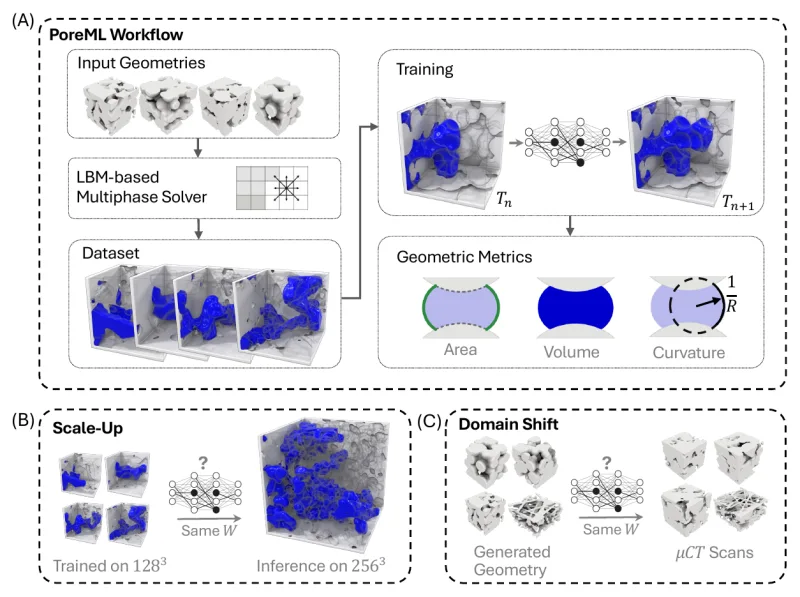
  1. PoreML: A Data-Driven Framework for Learning Multiphase Flow in Porous Media
    Chunyang Wang, Mingrui Zhang, Yuyan Zhang, Linqi Zhu, Xin Ju, Edo Sicco Boek, Martin J. Blunt, Gege Wen
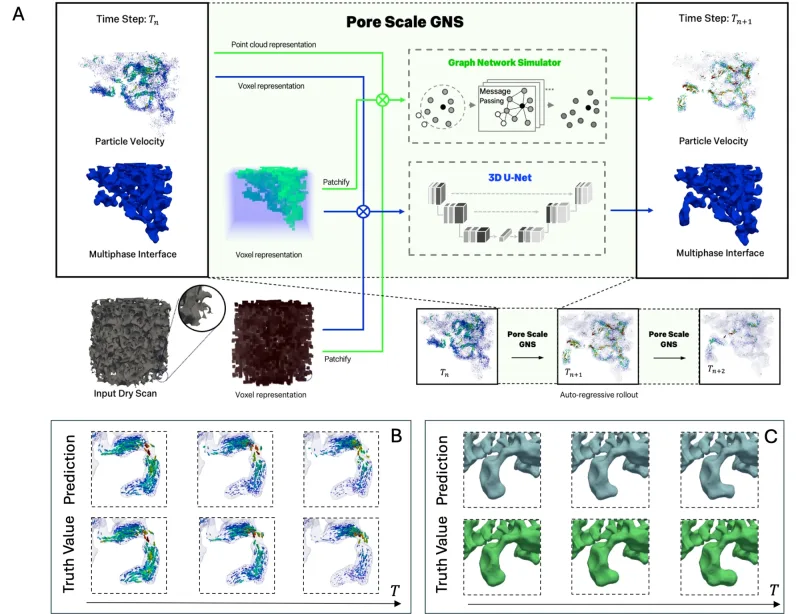
  2. Learning Pore-scale Multiphase Flow from 4D Velocimetry
    Chunyang Wang, Linqi Zhu, Yuxuan Gu, Robert van der Merwe, Xin Ju, Catherine Spurin, Samuel Krevor, Rex Ying, Tobias Pfaff, Martin J. Blunt, Tom Bultreys, Gege Wen
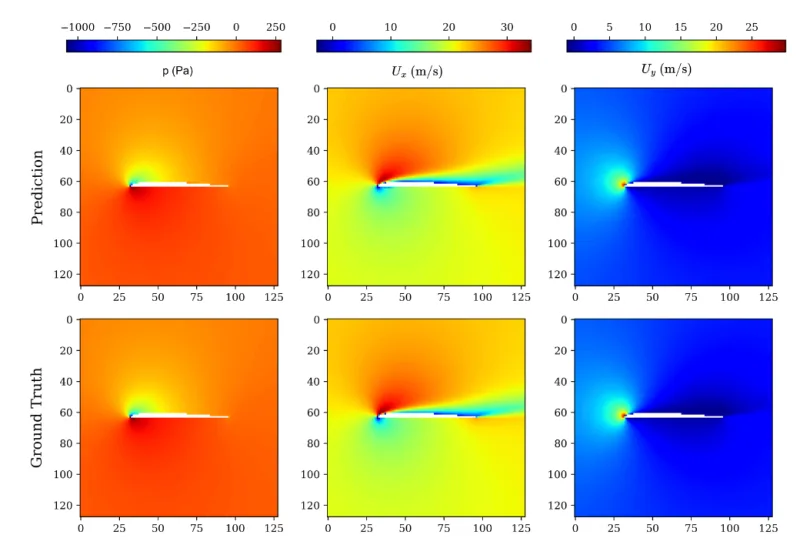
  3. AeroDiT: Diffusion Transformers for Reynolds-Averaged Navier–Stokes Simulations of Airfoil Flows
    Chunyang Wang, Biyue Pan, Zhibo Dai, Yudi Cai, Yuhao Ma, Hao Zheng, Dixia Fan, Hui Xiang
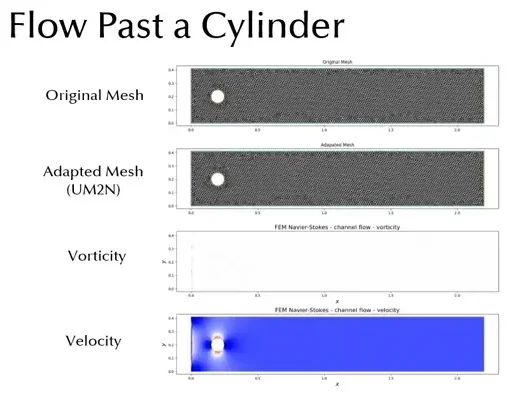
  4. Towards Universal Mesh Movement Networks
    Mingrui Zhang, Chunyang Wang, Stephan Kramer, Joseph G. Wallwork, Siyi Li, Jiancheng Liu, Xiang Chen, Matthew D. Piggott
    Spotlight Presentation

All publications on Google Scholar